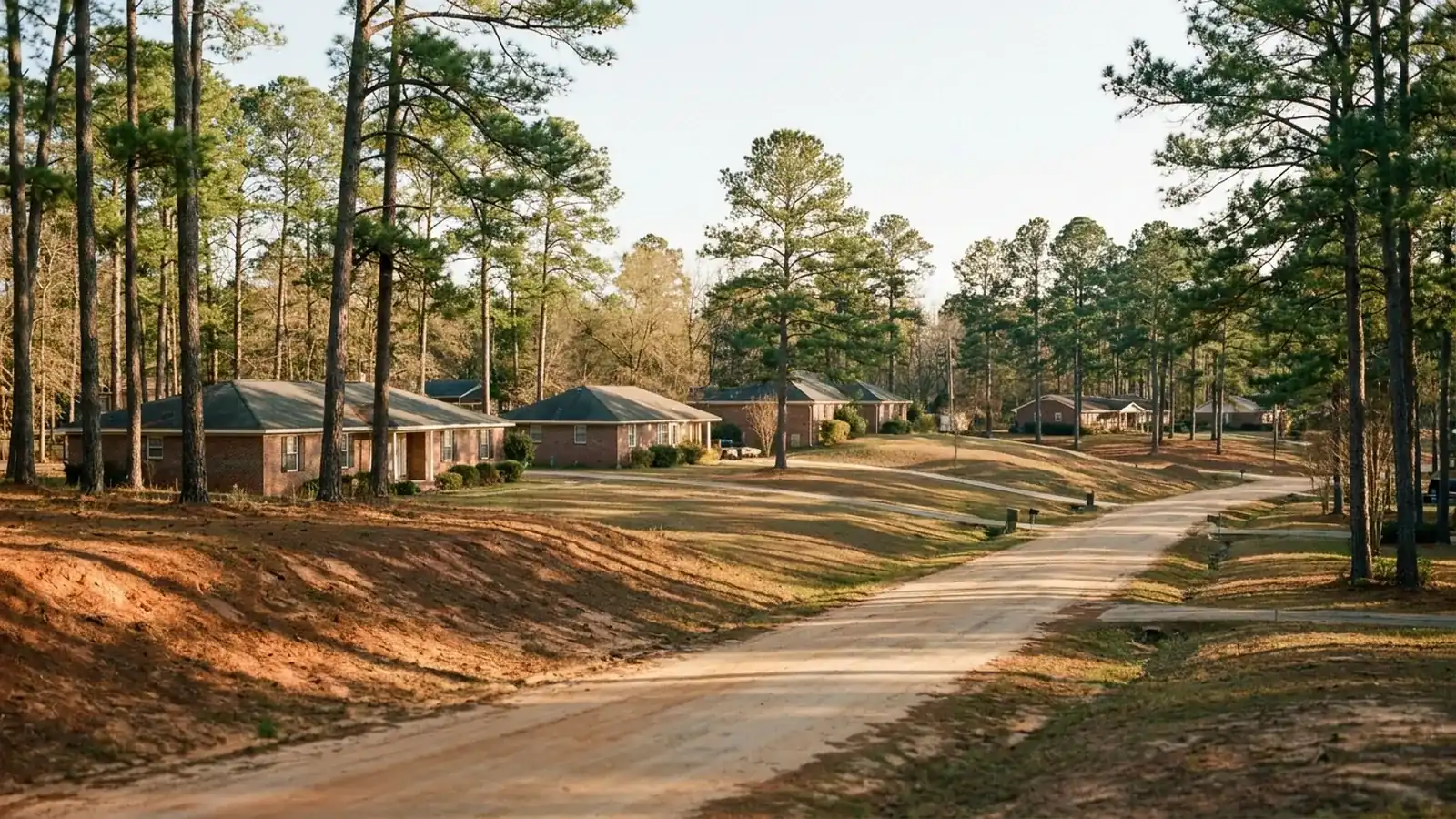
Helical piers in Hattiesburg cost $4,000–$15,000 for most full repairs, with piers commonly $1,200–$3,000 each. The Hattiesburg Formation is interbedded rather than uniform, so a driven pier can refuse on a sand lens and be called finished — a torque reading tells you what you are actually bearing in.
Why mixed layers make refusal ambiguous, what the torque log gives you, and when a driven pier is still the right answer.
Refusal is ambiguous when the ground is layered
The Hattiesburg Formation is a Miocene unit of green and bluish-green clay, sandy clay, sand and gray siltstone in alternating layers. A driven pier advancing through that can meet a resistant lens, stop, and satisfy a pressure gauge without having reached anything that will hold long-term.
A helical pier reports continuously. The torque needed to turn it through each layer correlates with capacity, so the installation record shows what was passed through as well as where it finished — which on this formation is the difference between a number and an assumption.
How a helical pier differs from a driven one
A push pier is hydraulically driven into the ground using the weight of the building as the thing it pushes against, until it refuses on something firm. A helical pier is screwed in, and the torque required to turn it correlates with the capacity it will carry — so it reports what it has found as it goes rather than only at the end.
That difference decides which is right far more often than price does.
What the log gives you afterwards
Each location's torque and depth are recorded and handed over. On a site where two corners can be founded in different materials, that record is what a future buyer's inspector, or a future engineer, will actually want to read.
It is also why the settlement evaluation surveys the whole floor rather than the room with the crack in it. The contour decides the pier plan; the torque decides each pier's depth.
The licence to check
Mississippi requires a Remodeler licence from the State Board of Contractors for improvements to an existing residence exceeding $10,000, under Miss. Code Ann. 73-59-1(c). Verify it here, for us or anyone else.
Helical piers, answered
What do helical piers cost in Hattiesburg?
$1,200–$3,000 per pier, most full repairs $4,000–$15,000. Depth varies across a single site here, so the per-location record matters.
Why can a driven pier be misleading here?
Because the formation is interbedded. A pier can refuse on a resistant sand lens and satisfy a pressure gauge without having reached material that will hold. Torque readings report continuously instead of only at the end.
What do I get in writing?
Torque and depth for every location, alongside the elevation survey that justified the pier plan. That is the document a future inspector or engineer will want.
Is a push pier ever right here?
A push pier is ever right here, where the structure is heavy enough to react against and the borings show a consistent bearing stratum. The evaluation says which case a house is.
Is a helical pier the right tool for this ground?
The Hattiesburg Formation is interbedded — clay, sandy clay, sand and siltstone in alternating layers — which makes torque-verified piers particularly honest here: the reading reports each layer as the helix passes through it.
| Option | What it does | On this ground specifically |
|---|---|---|
| Helical pier | Screwed in until the torque proves the capacity | The torque log is a soil boring you get for free — valuable in ground this variable |
| Push pier | Driven to refusal using the structure as ballast | Refusal can be ambiguous in interbedded layers — a firm band may not be the floor |
| Pressed pilings | Precast sections pushed down and capped | Workable, with the same question about what each section has stopped in |
| Stabilise the soil | Manage moisture so the ground stops moving at all | Real on this formation — layers with different swell potential answer to water control |
Because volume-change potential varies across a single footprint here, pier depths that differ across one house are not a red flag — uniform quoted depths are.
Get a free Hattiesburg elevation survey
Tell us which rooms are affected and which are not. On interbedded ground that contrast is the most useful thing you can give us — a house where the front is fine and the back bedroom is dropping is telling us something about what each end is sitting on. Same working day reply.